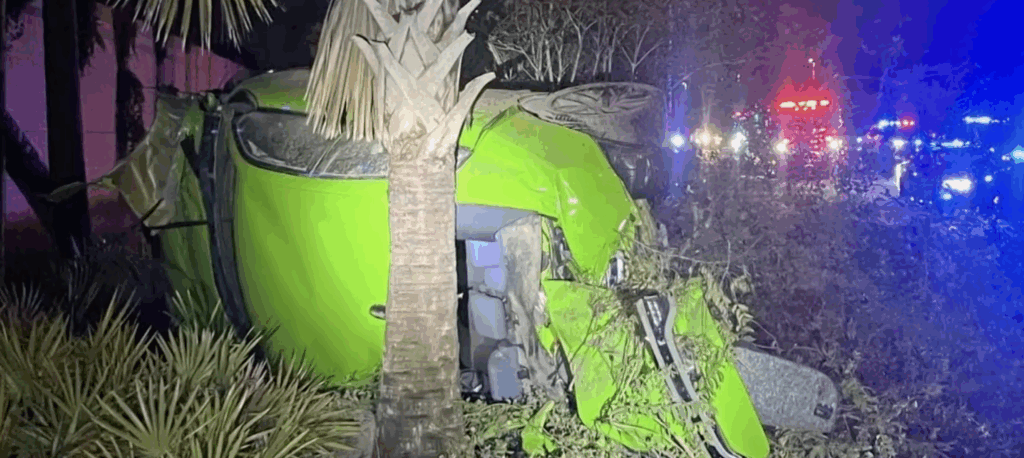
Recent High-Speed Crash on I-75 Highlights Injury Risks
We Don’t Take “Low” for an Answer!

By Lorne Adam Kaiser, Esq. (Fla. Bar No. 0568491) · Reviewed by Steve Romanello, Esq. · Kaiser Romanello Accident & Injury Attorneys · Published September 8, 2025
The short version: When a speeding driver crashes and injures the passengers riding with him, those passengers almost always have a claim — they didn't cause the wreck. On southbound I-75 in Hillsborough County, a Dodge Charger doing roughly 100 mph on bald tires lost control and hit trees, seriously injuring the driver and two passengers. This article explains who injured passengers can recover from, why their own uninsured/underinsured coverage often matters most, and the two-year deadline to act.
What Happened on I-75 in Hillsborough County
Around 9:30 p.m., a 25-year-old driver lost control of a Dodge Charger on southbound Interstate 75 in Hillsborough County. According to the Florida Highway Patrol, the car was traveling near 100 mph on bald tires over wet pavement when it began to rotate, struck an embankment, went airborne, and collided with trees. All three occupants — the driver and two passengers, ages 24 and 25 — were hospitalized with serious injuries. FHP attributed the crash to excessive speed, poor tire condition, and wet roadway.
Speed turns an ordinary loss of control into a catastrophe. Nationally, speeding is a factor in roughly 29% of traffic deaths, according to the National Highway Traffic Safety Administration — and a car leaving the roadway at highway speed subjects everyone inside to the kind of forces that cause brain, spine, and internal injuries. For the people hurt in a crash like this, the legal questions come fast: who is responsible, and whose insurance pays.
Source: This post is based on information released by the Florida Highway Patrol.
If You Were an Injured Passenger, You Almost Always Have a Claim
This is the part the headlines miss. When a single car crashes because of how it was being driven, the passengers are, by definition, not the ones who caused it — and Florida law lets an injured passenger pursue the at-fault driver for their injuries, even when that driver was a friend, a relative, or the person who offered them a ride. The driver who caused the crash generally cannot recover for his own injuries, but the passengers can.
Passengers are rarely at fault
In a crash caused by speeding and bald tires, the passengers had no control over the vehicle. That usually means little or no comparative fault falls on them — and a strong claim against the driver responsible for the crash.
There can also be more than one responsible party. If the Charger belonged to someone other than the driver, Florida's dangerous instrumentality doctrine can hold the vehicle's owner responsible for entrusting it to a driver who then operated it negligently. And where a mechanical condition like bald tires contributed, whoever was responsible for maintaining the vehicle may share liability. Sorting this out takes an investigation, not a phone call to the other side's insurer.
Which Insurance Actually Pays — and Why UM/UIM Is Critical Here
Florida car-crash claims are built in layers, and in a case with three seriously injured people, the layers matter enormously:
- Your own PIP (first). Under Florida Statute §627.736, each occupant's own Personal Injury Protection pays first — 80% of medical bills and 60% of lost wages up to $10,000 — regardless of who was at fault. You generally must seek treatment within 14 days of the crash to keep this coverage, so prompt care is essential.
- The at-fault driver's Bodily Injury (BI) liability coverage. This is what compensates injured passengers beyond PIP — but Florida does not even require drivers to carry BI, and a single policy split among three badly hurt people is often far too small to cover everyone's losses.
- Uninsured/Underinsured Motorist (UM/UIM) — often the most important layer. When the at-fault driver has no BI coverage, or not nearly enough for three serious injuries, an injured passenger's own UM/UIM policy (or that of a resident relative) can step in. In Florida, UM/UIM can sometimes be "stacked" across vehicles, dramatically increasing what's available. Many people don't realize this coverage protects them as passengers in someone else's car.
Identifying every applicable policy — the driver's, the owner's, and each passenger's household coverage — is one of the most valuable things a lawyer does early in a case like this. It is the difference between a recovery capped at $10,000 and one that reflects the true cost of a serious car accident.
Serious Injuries and the Right to Full Compensation
A crash that sends a car airborne into trees produces exactly the kind of injuries Florida's serious-injury threshold was written for. Under Florida Statute §627.737(2), an injured person can step outside the no-fault system and pursue the at-fault driver for the full measure of damages — including pain and suffering — when they suffer a permanent injury, significant and permanent scarring or disfigurement, or a permanent loss of an important bodily function.
High-energy highway crashes frequently cause injuries that meet this threshold: traumatic brain injuries, spinal damage, and orthopedic injuries requiring surgery. These carry costs — future medical care, lost earning capacity, lifelong limitations — that a $10,000 PIP policy comes nowhere near covering, which is exactly why the liability and UM/UIM layers above matter so much.
Florida's Two-Year Deadline (HB 837)
Florida's 2023 tort-reform law, House Bill 837, shortened the statute of limitations for negligence-based injury claims from four years to two years from the date of the crash, and moved the state to a modified comparative-negligence standard (a person found more than 50% at fault recovers nothing). For injured passengers, that 51% bar is rarely a concern — they didn't cause the crash — but the two-year clock applies to everyone.
⚠ Two Years to File
In most Florida car-crash cases, you have two years from the date of the crash to file a lawsuit. Serious-injury cases with multiple insurance layers take months to investigate and document, so it is best to act well before the deadline — while evidence still exists.
Why Moving Quickly Protects Your Case
The proof that establishes what happened begins disappearing almost immediately, and in a speed-and-tire case the physical evidence is decisive:
- The vehicle itself. The Charger's Event Data Recorder ("black box") can confirm pre-crash speed, throttle, and braking, and the tires document the "bald" condition FHP cited — but once a totaled car is released to salvage and crushed, that evidence is gone. A preservation letter can stop that.
- The scene. Yaw marks, the embankment strike, the airborne path, and the final rest position let a reconstructionist calculate speed and sequence — until weather and traffic erase them.
- The FHP investigation. The full crash report, trooper narrative, and any homicide-unit or reconstruction findings should be obtained and locked down early.
- Insurance and household policies. Every occupant's PIP and UM/UIM coverage needs to be identified before deadlines and coverage disputes narrow the options.
Getting a lawyer involved early isn't about rushing to court — it's about making sure the evidence and the coverage that fund a fair recovery are still there when it counts.
Frequently Asked Questions
Can an injured passenger sue the driver of the car they were riding in?
Yes. In Florida, a passenger injured by the driver's negligence can pursue that driver's insurance, even if the driver is a friend or family member. You are making a claim against an insurance policy, not personally targeting the person — and as a passenger, you almost certainly did not cause the crash.
What if the driver's insurance isn't enough to cover three injured people?
That is common in serious crashes. When the at-fault driver has too little coverage (or none), an injured passenger's own uninsured/underinsured motorist (UM/UIM) coverage — or a resident relative's — can provide additional compensation, and in Florida that coverage can sometimes be stacked. Identifying every available policy is critical.
Does it matter that no other car was involved?
No. A single-vehicle crash still involves a negligent driver, and the injured passengers can recover from that driver's coverage. There may also be additional responsible parties — the vehicle's owner under Florida's dangerous instrumentality doctrine, or whoever was responsible for the bald tires and vehicle maintenance.
What if I was partly hurt because I wasn't wearing a seatbelt?
You may still recover. Under Florida's comparative-negligence rule, your compensation can be reduced by the percentage of fault assigned to you, but a passenger who didn't control the vehicle typically bears little or none. Don't assume you have no case — have the facts reviewed.
How long do I have to file a claim after a Florida car accident?
Under HB 837, you generally have two years from the date of the crash to file a negligence lawsuit. Because serious cases take months to build, it's best to speak with an attorney within days of the accident rather than waiting.
How Kaiser Romanello Helps Injured Passengers
We handle serious car-accident and catastrophic-injury cases across Florida, and we build them to be tried, not just settled. For injured passengers, that means moving quickly to preserve the vehicle and black-box evidence, identifying every applicable policy — the driver's, the owner's, and each passenger's own PIP and UM/UIM — retaining accident-reconstruction and medical professionals where the facts call for it, and dealing with the insurers so you can focus on recovering. You work directly with the attorneys on your case, and there is no fee unless we recover for you. With roughly 381,000 crashes reported statewide in 2024 alone, per the FLHSMV, these cases are common — and each one runs on the same two-year clock.
Injured as a passenger or driver in an I-75 or other Florida highway crash? Find out where you stand — free, confidential, and no fee unless we win.
(844) 877-8679 Request a Free Case ReviewThis article is for general informational purposes only and is not legal advice; it does not create an attorney-client relationship. The facts described are drawn from public news reports and law-enforcement statements and may not reflect later developments. Every case is different and depends on its specific facts. Past results do not guarantee, warrant, or predict future outcomes. Kaiser Romanello, P.A., 11555 Heron Bay Boulevard, Suite 200, Parkland, FL 33076.
Contact Us Today
Recent Victories for Clients
$5 Million
Negligent Security
$4 Million
Truck Accident
$1 Million
Ride Share
$1 Million
Car Accident
“Kaiser Romanello changed my life. They are The Dream Team! Could not recommend them anymore! If you want to get the most money for your personal injury claim call Kaiser Romanello today!”

-Lu R
Former client

“l just got off the phone with Mr. Loren Kaiser for a free consultation and he was absolutely amazing. He was extremely helpful, detail oriented and did not add any “rushed” feeling to the phone call. If I have anything substantial to move forward with, I will proudly utilize this law office. Thank you, Mr. Kaiser, for your help, input and advice! It is greatly appreciated.”

-Trina R
Former client
“Steve and his partner are just very knowledgeable, amazing client service, Steve it is the kind of persons who loves what he is doing, he went about and beyond his lawyer responsibilities in my case, they care about you, If you are looking for professionals at the highest levels, use their services. Not only you will be represented by top lawyers, but you feel like part of the family. Thanks for everything, God bless you.”

-Carlos V
Former client